

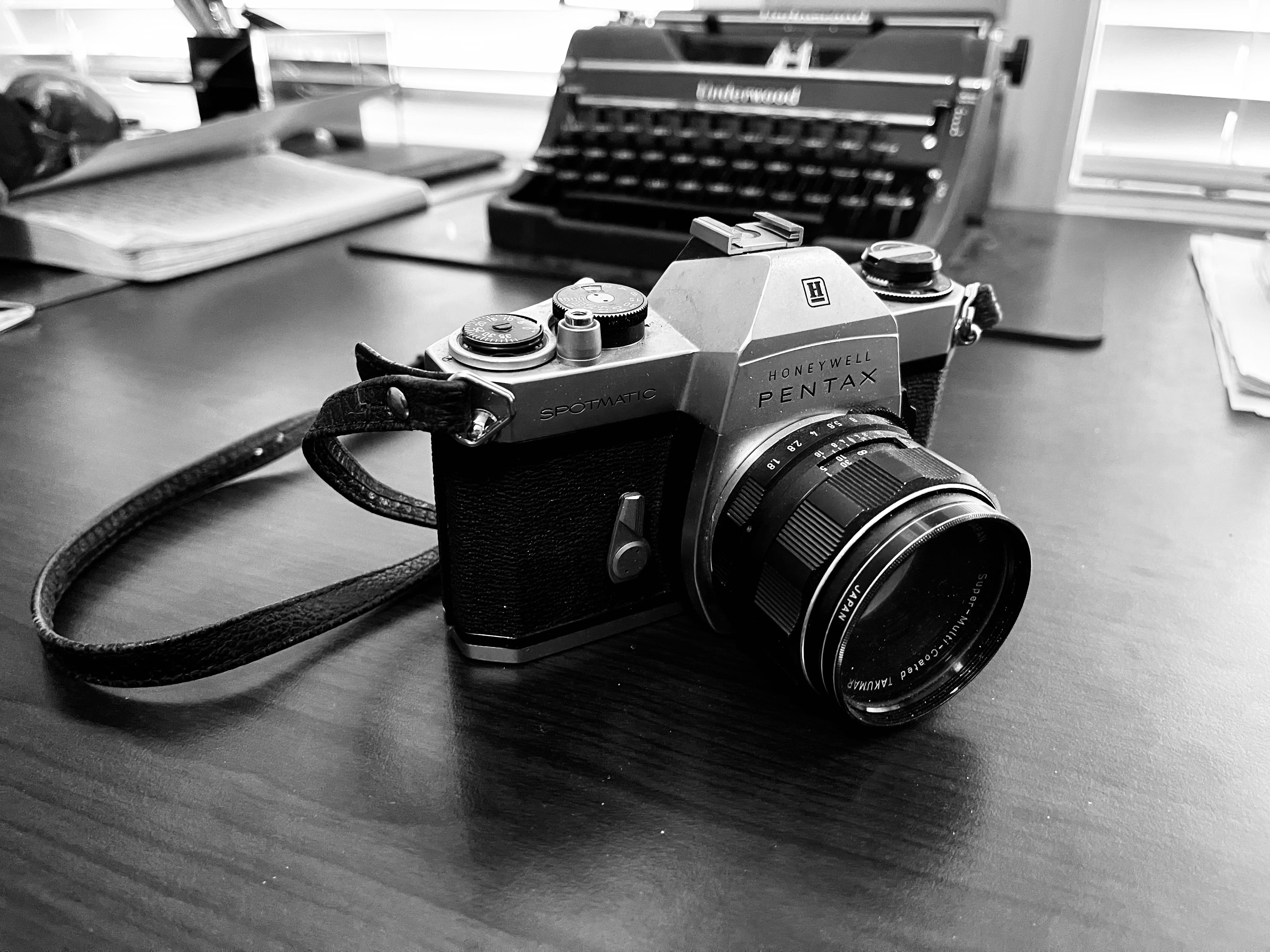
It is sitting in the back seat at the end of my shift, discarded or forgotten. Was it from the last passenger? Or did the last passenger assume it was mine and not mention it to me? It cannot have been there long without somebody saying something. It is late at night. People forget things. But it doesn’t take long before I notice or someone calls it to my attention. How long has this camera been sitting here?
It’s an SLR. Not a DSLR, but an SLR. As in, not digital. A film camera. A Pentax Spotmatic, to be specific. About a $200 camera. It’s worn in. It looks like it’s gotten a lot of use. It’s not something many casual photographers would use anymore. Photography is likely a hobby this person is serious about.
I know the feeling of a serious hobby. I know the pain of losing work. And I know that, while it always sucks to be out $200, an artist’s instrument can also have any level of sentimental value, and whatever is on the film might be worth more to the owner than anything. So I report it in the app and note that it would likely belong to one of the last few riders of that day.
Two days later, a message from the support staff informs me they have not been able to find the owner.
I try sending messages to some of those passengers myself. They tell me they didn’t lose a camera, if they bother to respond at all. Try as I might, I cannot find the owner of this moderately expensive and likely sentimental piece of equipment, with film inside it that could be worth any amount at all.
Why would someone not claim it?
And that’s where my writer brain kicks in. I’ve been narrating true crime books, reading story after story of serial killers, jealous spouses, and all manner of sick individuals. My mind focuses on the film—the handful of exposures saved forever within the camera. What are they? What moments are immortalized within those flashes of light?
I imagine a murderer, his camera forgotten, receiving messages to ask if it’s his. He cannot answer, for what if the film has already been developed? What if someone knows, and as soon as he admits to ownership of the camera, he has admitted to the crime?
I imagine myself stricken with curiosity, taking the photos to be developed, only to find the FBI at my door before I’m even told the photos are ready. I see myself in cuffs, baffled by a barrage of questions about photos of bound and tortured individuals.
Or I imagine myself thinking, No, the photos weren’t for me. It would be a violation for me to look at them. So I toss the film, never to be seen by human eyes, and the evidence of sadistic evil that could have been finally unearthed instead remains buried. The killer stays at large, and more people die who perhaps could have lived if only I’d looked. If only I’d been nosier.
And even though I know it’s probably just friends and family, a birthday party, landscapes—even though I know almost all photos are harmless—I also know anything is possible. The film on an orphaned camera, the flashes of a life, could be any life. Any moment of a life. Even the last moment.
And so it sits on the table in my apartment—lonely, mysterious, and bursting with infinite possibility. Now and then I glance at it and wonder, Whose camera were you? Why don’t they want you? What did you see?
Memoirs of a Rideshare Driver is a series that tells true stories from my 10,000+ trips as a rideshare driver. I will post new stories every month in 2026.
What ever happened to the camera?